I’m a father of three. A lifelong student. A builder of occasionally peculiar things. I want my kids to know the delight of a small “why?” becoming a gloriously tangled “hang on a minute…”
AI makes answers easier to find. Could it also help us discover questions worth asking—and enjoy the wonderfully messy business of figuring things out?
That question grew a rabbit hole. You’re looking at it.
Room for one more why
Every child deserves room to wonder.
Even when the wondering gets mud on the carpet.
I don’t think a child should need an exceptional teacher, a particularly curious parent, or a skilled mentor to have room for inquiry. Curiosity is everywhere. Opportunity is not. I’m exploring whether CTL can make more of that room available.
My kids have room to explore. Not every child has the same access to enrichment and individualized intellectual support. In the 2025 America After 3PM findings, parents of an estimated 22.6 million children wanted afterschool programs their children did not attend. That measures unmet demand for programs, not a gap in children’s curiosity or a direct measure of reflective inquiry. It reminds me that opportunities are unequal. Whether CTL can help is something I still need to test.
Two possible openings
First, a little “huh?” Then, perhaps, a rabbit hole.
Inquiry Activation
“Huh. That’s odd.”
A passing thought. A thing that doesn’t quite add up. Something everyone else seems perfectly happy to walk past.
Perhaps there’s a question hiding in there. I want to see whether CTL can help a child notice it—and decide whether to follow.
Inquiry Quality
“Wait. What’s underneath?”
Turn the thought around. Look underneath. Give the assumption a gentle wobble.
CTL may help a participant examine assumptions, consider other perspectives, weigh evidence, and refine an understanding. That’s the possibility I’m exploring.
Meet MORQ · Yes, I gave it a name
A few odd tools for a wandering mind.
I developed MORQ as CTL’s way of supporting meaningful inquiry through reflection, alternative perspectives, and intellectual challenge without taking ownership of your thinking.
A pocketful of possibilities. No marching orders.
MORQ draws on four elements as they become useful.
MIRROR
“Is this what you mean?”
Reflect what you actually mean, distinguishing what you’ve said from what the AI has inferred.
OPEN
“There’s another window over here.”
Introduce a credible alternative perspective to expand what you can consider.
REFLECT
“Well, that’s a curious knot.”
Examine assumptions, implications, tensions, and uncertainties without prematurely deciding what you mean.
QUESTION
“One more why?”
Invite another question when doing so is genuinely useful. Asking a question is optional, not mandatory.
My thoughts didn’t get the memo about straight lines.
Real inquiry can be messy. We reconsider assumptions, change direction, discover unexpected questions, and sometimes realize we misunderstood something entirely.
I designed MORQ to make room for that wandering. Including the occasional “Oh. I may have had that entirely backwards.”
Sometimes reflection is enough. Sometimes another perspective opens up an unexpected possibility. Sometimes a question is useful. And sometimes the participant simply wants to move in another direction.
I designed CTL to preserve the evolving inquiry, including corrections and uncertainty, without turning the AI’s interpretations into established conclusions.
You hold the shovel.
Challenge CTL. Change your mind. Follow a new idea. Ask for an answer. Or stop.
The inquiry belongs to the person, not the AI.
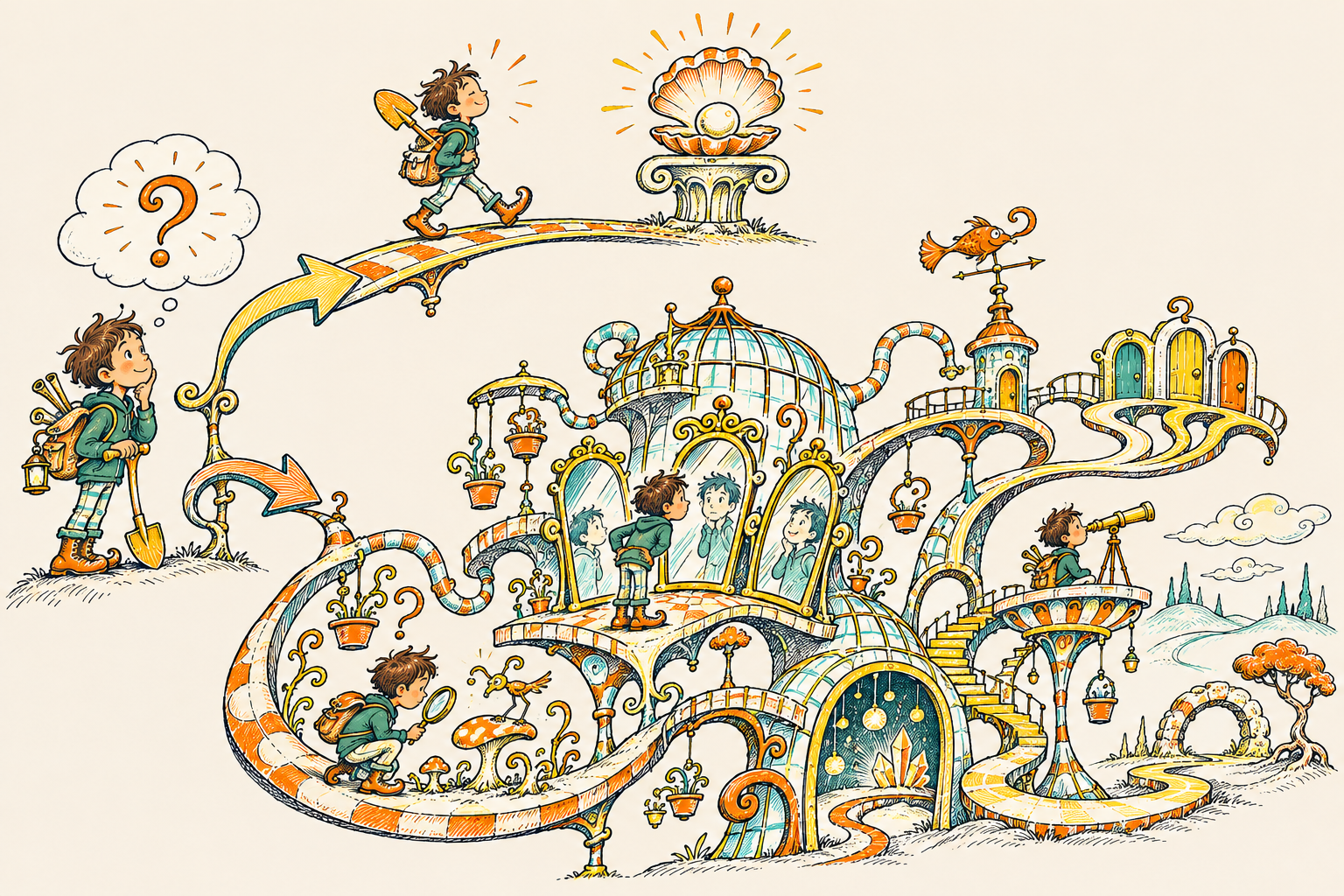
A map of what might happen
A possible path. Plenty still to discover.
An imagined place to wander. The map below explains the proposed difference between a quick answer and CTL.
?
Same curious thought. Different next step.
“I wonder about this…”
↗
The quick answer
A perfectly useful route when an answer is what you need.
1
Ask AI
The person asks a question.
2
Get an answer
AI responds directly.
3
Move on
The question may end there.
Possible tradeoff: less time to examine assumptions, try another view, or find a better question.
↝
With CTL
The question becomes a place to explore.
1
Reflect
CTL checks what the person means. They can correct it.
2
Open a window
It offers another credible view or surfaces an assumption.
3
The person chooses
Go deeper, redirect, ask for an answer, or stop.
What I hope to test: whether this invites inquiry, helps people examine ideas, and preserves their control.
✳
Rather than using AI simply to provide answers, I wanted to explore whether it could help people discover questions, challenge assumptions, and develop their own understanding. Could CTL help people take greater ownership of their thinking and make meaningful inquiry more accessible? That’s an open question and the one that led me down this rabbit hole.
I hope parents and educators can one day introduce children to CTL as an invitation to explore, not another lesson to complete. My goal is simple: give children room to follow their own curiosity without needing an expert to guide every step. Adults can make that opportunity available, while CTL may help children explore the questions that matter to them.
Adults open the door. CTL offers a place to explore. Children choose which questions to follow.
Adult supervision, safeguarding, age eligibility, and privacy requirements remain separate conditions for responsible use and research. This page is not an invitation for children to use CTL unsupervised.
The experiment is still experimenting
I built a rabbit hole. Now I need to see where it leads.
A peculiar name and a bent staircase are not evidence. I checked.
I’m currently studying how adults experience CTL: whether it invites exploration, supports thoughtful inquiry, and gives people meaningful control over their developing understanding. I’m also looking for what doesn’t work—unnecessary friction, unwanted influence, and whether participants find value beyond what they already get from ordinary AI.
But I haven’t forgotten why I started building CTL in the first place. Could it eventually give more children the opportunity to follow their curiosity and develop their own thinking?
These studies inform my questions about afterschool access, AI-assisted learning, and human reliance on AI. None establishes that CTL works.
Afterschool Alliance, America After 3PM (2025) — A survey of 30,515 U.S. parents estimated unmet demand for afterschool programs for 22.6 million children. Cost and access were major barriers—evidence of unequal opportunity, though not a direct measure of children’s access to reflective inquiry.
Bastani et al., Generative AI without guardrails can harm learning (2025) — In a high-school mathematics experiment, unrestricted AI assistance improved practice performance but reduced later performance without AI. A tutor using teacher-designed hints largely avoided that harm, suggesting that how AI helps matters for what students learn.
Buçinca et al., To Trust or to Think (2021) — An experiment with 199 participants found that designs requiring more deliberate thought reduced reliance on incorrect AI advice compared with simple explanations. The most effective designs received the lowest subjective ratings, revealing a tension between thoughtful engagement and ease of use.
Contractor and Reyes, Experimental Evidence on the Learning Impact of Generative AI (2026) — A randomized undergraduate experiment reported in this preprint found that AI access improved unaided test scores, with smaller gains remaining a week later. Participants who used AI for explanations showed more sustained benefits than those who delegated writing, though those usage patterns were not randomly assigned.
Lee et al., The Impact of Generative AI on Critical Thinking (2025) — A survey of 319 knowledge workers linked greater confidence in AI with less self-reported critical thinking, and greater confidence in their own task ability with more. These associations raise questions about judgment; they do not establish cause and effect.
Bull, Negotiated Learner Modelling to Maintain Today’s Learner Models (2016) — Examines educational systems where learners could inspect, challenge, and correct representations of their knowledge. Earlier studies suggest potential benefits for reflection and model accuracy, offering a useful precedent for making a system’s interpretation open to challenge.
Anyway. That’s why there’s a rabbit hole. Mind the first step. It has questions.